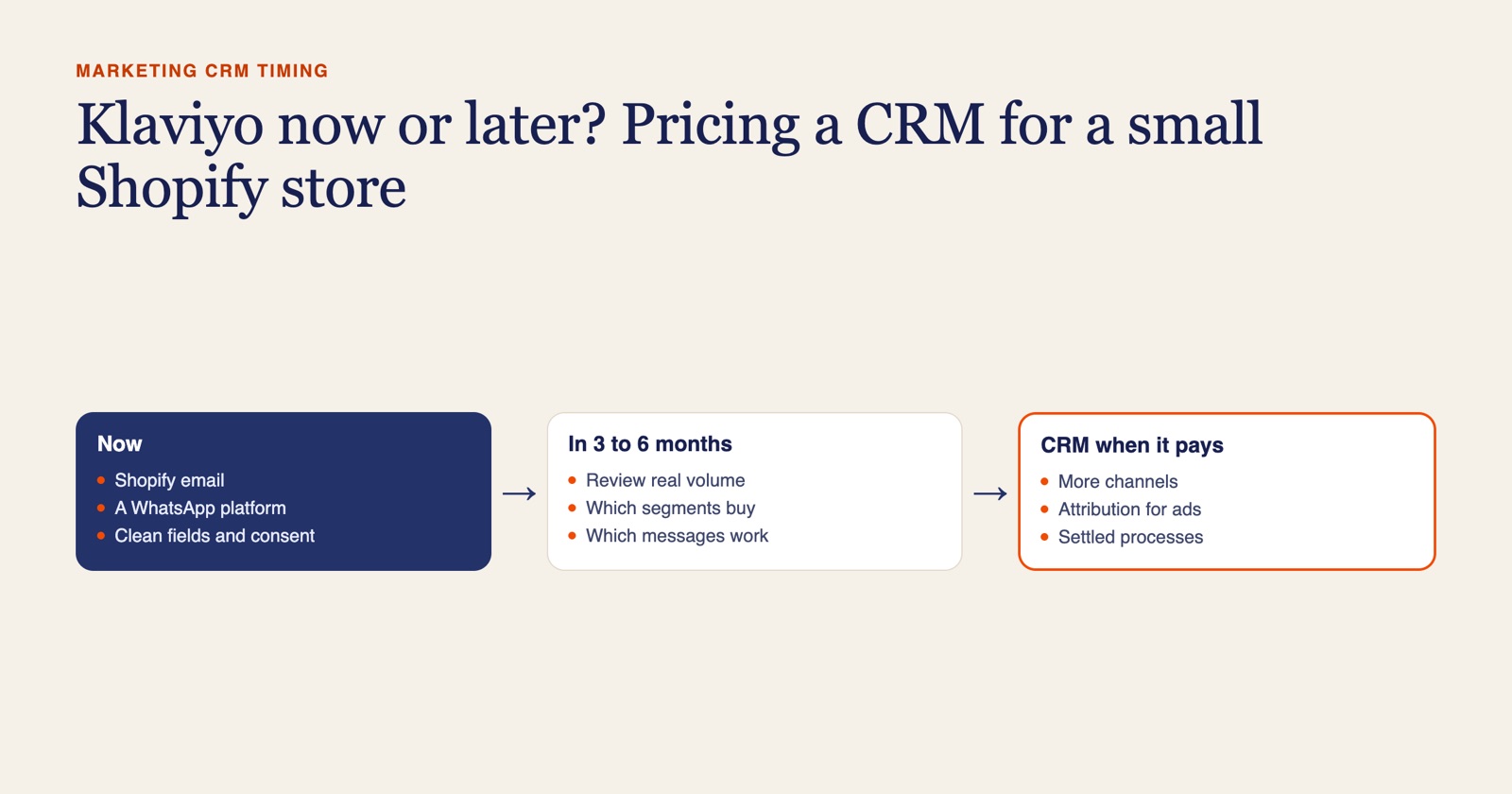
Switch to Klaviyo when your store has steady volume, runs three or more messaging channels, has someone whose job is marketing, and needs to know which flow or campaign paid for the ads. Before that, Shopify's own email plus a WhatsApp platform connected to the store covers most of what a small shop needs for much less. That is what we recommended to a small Shopify gifting store in the UAE. The owner's real worry was the move later: if we start on Shopify now, are we stuck in a year? The answer depends far more on how the store keeps its customer data today than on which tool it buys.
This post is about that timing decision and how we priced it. The wider story of the project, including the problems we found in the store and the flows we planned, is on our main site.
What does each option actually cost a small Shopify store?
We put the two realistic routes side by side. Neither is free, but they get expensive in different places.
| Shopify email + WhatsApp platform | Klaviyo now | |
|---|---|---|
| How the software is billed | Shopify's email is part of the Shopify plan, within its sending allowance. A WhatsApp platform such as BotSpace starts at about $15 a month (about AED 55). | Free up to 250 active profiles and 500 email sends a month. Paid plans are priced by the number of active profiles. |
| What makes the bill grow | Meta's per-message fees: about AED 0.183 per marketing message in the UAE, about AED 0.058 per utility message, replies inside the 24-hour window free. | Every new subscriber or customer profile. Your list growing is your bill growing, whether or not you email those people. |
| Setup project | Smaller. Shopify already holds orders and customers, so the work is consent, fields and the flows themselves. | Bigger. Connecting the store, rebuilding welcome and checkout flows, moving the list and setting up tracking. |
| Where it is weak | Reporting across channels, predictive segments and complex branching. | Paying for depth a two-person team will not use yet, and a setup built around processes that are still changing. |
The 250-profile free tier sounds generous until you count. Every pop-up sign-up, every checkout and every imported customer is a profile. A store running a sign-up offer and importing its existing customers can pass that limit within a month, and from then on it pays every month for the size of its list. That is a fair model for a store getting value from the list. For a store still fixing the basics it is a fixed cost with nothing yet to show for it.
Why is a second setup the real cost of choosing too early?
Owners compare monthly prices. The bigger number is the setup project, and the risk is paying for it twice. If you choose a full marketing CRM now and it turns out to be the wrong one, or the right one set up the wrong way, the second setup costs as much as the first and comes with a migration on top.
A CRM migration involves more than exporting a spreadsheet. Lists, segments, automations, the way enquiries are handled and any ad-platform connections have to be rebuilt the new platform's way. Imported customers must be flagged so they do not suddenly receive a welcome series meant for strangers. I have watched a migration between two large CRMs, with tens of thousands of contacts, take the best part of a year. A small store will not face that scale, but the same steps apply, and every one is cheaper on clean data.
Why does picking a CRM before processes settle backfire?
A CRM is configured around how you work: which statuses an order passes through, what a good enquiry looks like, which customers count as repeat buyers. Choose it before those are settled and you end up with a system shaped for a business you no longer run.
This store had just relaunched. Its orders were marked fulfilled when they left the building, and nothing recorded when they were delivered. Build delivery and review flows in an expensive tool on top of that and they would trigger at the wrong moment or not at all. The fix was a process change: the team records out for delivery and delivered, one tap each. That had to happen first, whichever tool came later. Once the team has run real peaks with real flows, they know what they need, and a CRM can be specified from experience rather than from a sales demo.
What are the signals that it is time to switch to Klaviyo?
We gave the owner a short list to check at the 3 to 6 month review. One signal on its own is not enough. When three or more are true, it is time to price a CRM properly.
- Volume: campaigns go out every week or two rather than only at peak dates, and the opted-in list has grown into the thousands, so better segmentation and testing would show up in sales.
- Channels: you run email, WhatsApp and SMS (or more) and want one place to decide who hears what and how often, instead of separate rules in separate tools.
- Team: someone owns marketing as part of their job, not the owner late in the evening, and more than one person builds campaigns.
- Ads: you spend enough on Meta or Google ads that you need revenue tied to each campaign and flow, and want to send audiences back to the ad platforms.
- Flows: you need things Shopify cannot do well, such as segments based on predicted next order date or customer value, or one flow that branches across email, SMS and WhatsApp depending on how each person behaves.
If none of these is true yet, a CRM mainly adds cost. The owner reached the same view on the call: a proper CRM is where the store is heading, but the business is not there yet. With a small team the money goes further on the basics, and once the store takes off, a CRM subscription is easy to justify.
What should you do now so a later move is just an import?
This is the part that decides whether switching in a year is a week of work or a clean-up project. None of it needs a new tool.
- 1Store data in proper fields, not notes. The store's sign-up form was saving WhatsApp numbers into the customer's free-text note, where no automation and no import tool can read them. Give the WhatsApp number, occasion date, recipient and delivery area their own fields.
- 2Record consent per channel, honestly. Email consent and WhatsApp consent are separate, and a box nobody ticked is not consent. This store's form was marking every sign-up as subscribed to email. A future CRM will trust whatever you import, so the record has to be right at the source.
- 3Keep one tag list and stick to it. Decide the tags once (source, occasion interest, consent status, imported or new) and write them down. Three spellings of the same tag become three segments in the new tool.
- 4Tag imported contacts by where they came from. Customers brought in from staff phones should be marked as imported, with their consent status, so no tool treats them as fresh sign-ups.
- 5Put every account in the business's own name. The Shopify store, the WhatsApp platform, the Meta business account and the phone number should belong to the business and be billed to it directly. Then the data can always be exported, whoever set it up.
- 6Write down each flow: its trigger, what it says, and what stops it. That page becomes the specification for rebuilding the flows in a CRM, and it saves a week of guessing.
What did we recommend for this store?
Shopify stays the source of truth for orders, customers and subscriptions, and sends the email. A WhatsApp platform connected to Shopify handles WhatsApp, including a shared team inbox to replace staff phones. Seven flows, from welcome to seasonal campaigns, each with a rule for when it stops. The plan is three weeks, starting with the nearest peak, with software and Meta fees billed to the business directly so the accounts and data stay in its name. Then a CRM review in 3 to 6 months, against the signals above.
This is a proposal, not a finished project, so there are no results to report yet. What we can say is that the data fixes in the first week help whichever way the review goes.
Common questions
When several of these are true at once: steady campaign volume and a list in the thousands, three or more messaging channels, someone who owns marketing, ad spend that needs revenue attribution, and flows Shopify cannot run, such as predictive segments or one flow branching across channels. If only one is true, Shopify's email plus a WhatsApp platform is usually enough.
Klaviyo's free plan covers up to 250 active profiles and 500 email sends a month. Paid plans are priced by the number of active profiles, so the cost grows with your list. Check the current figures on Klaviyo's pricing page before you budget.
Klaviyo connects to Shopify, so orders and customers come across. What makes the move slow is messy data: phone numbers in notes, consent that was never recorded per channel, and tags spelled three ways. Fix those now and the move is mostly an import plus rebuilding the flows.
Yes, if Shopify stays the source of truth for customers and the WhatsApp platform writes its details back to Shopify fields. Then a CRM added later reads from one clean record instead of two half-records.