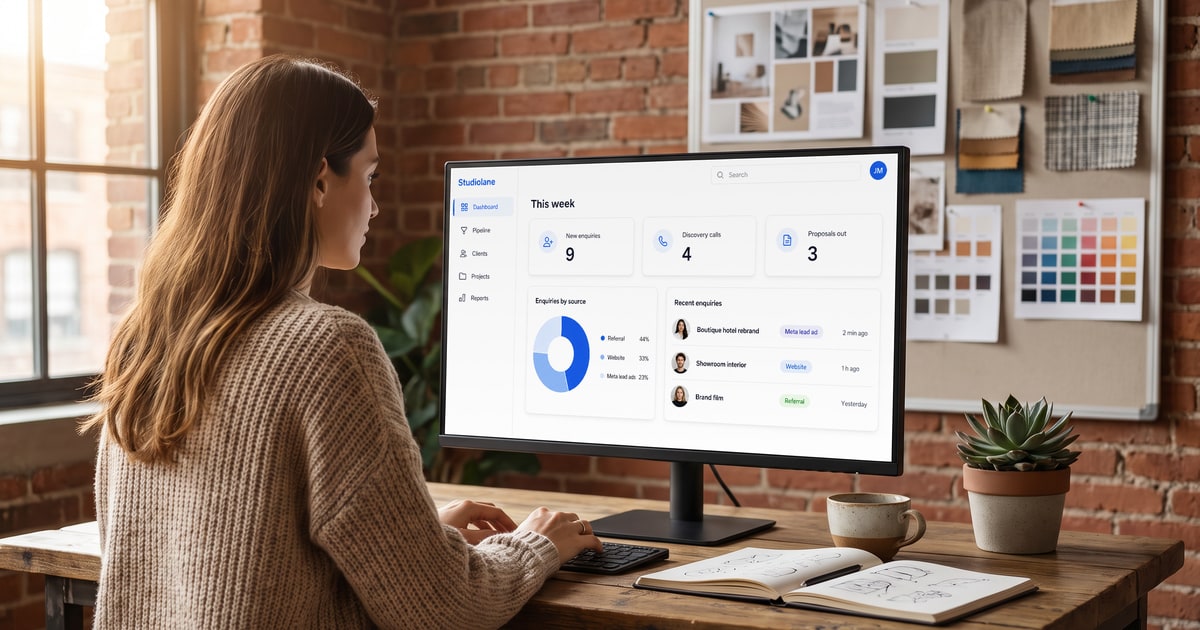
A CRM for a design or media studio puts every enquiry (ad lead forms, website, inbox and DMs) into one pipeline, alerts the right person straight away, and keeps project phases and quotes on the same client record. Ask a studio principal where last month's enquiries are and the answer is often a shrug followed by a list: some in the shared inbox, a few in Instagram messages, a spreadsheet someone started in January, and a stack of ad-platform leads that nobody has opened since the campaign launched. The work is excellent. The pipeline is a memory exercise.
We build the system that replaces that memory exercise. This guide is for design, architecture, production and media studios in the United States deciding whether CRM development is the right next move, and what a good build looks like when it is.
When does a studio need a custom CRM rather than a template?
Custom CRM development beats an off-the-shelf tool when your pipeline has stages, people or data the tool cannot model without a pile of workarounds. Studios hit that wall sooner than most businesses, because a lead is not a one-off sale. It is a relationship that may run for months and turn into a project with phases, collaborators and approvals.
- Leads from everywhere, owned by nobody. Ad-platform lead forms, the website contact page, email and direct messages all arrive in different places. A custom build pulls them into one queue with the source attached.
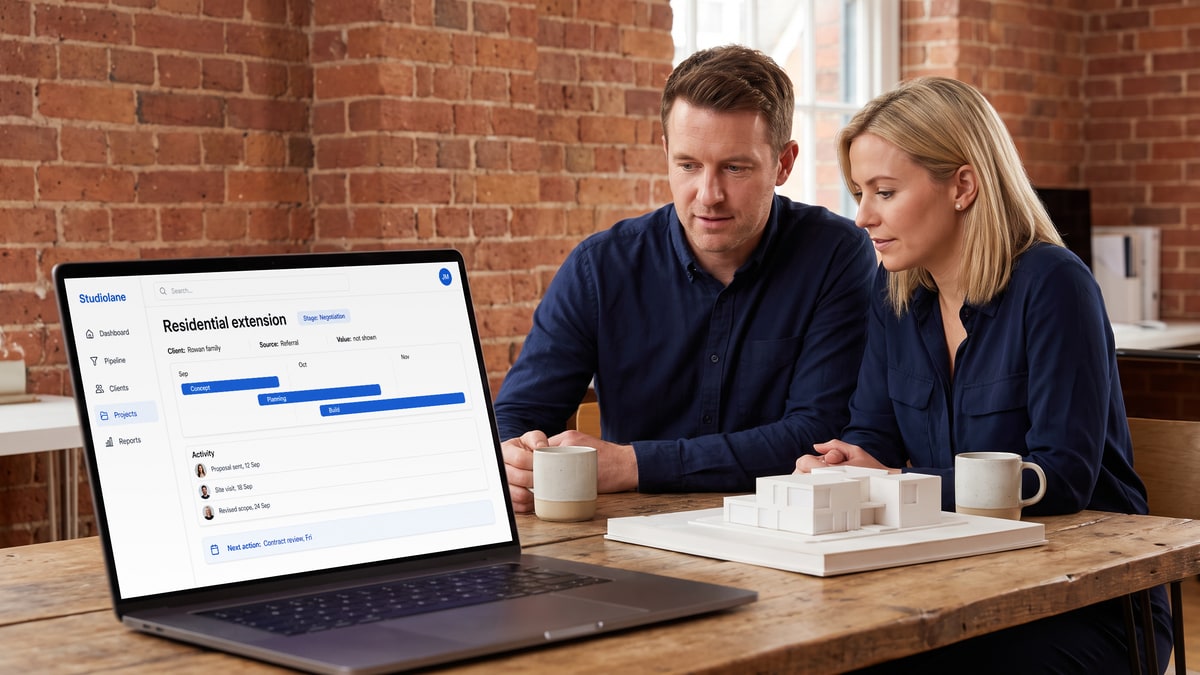
- Project data beside the client. Who the client is, which phase the job is in, which consultants are involved and what has been quoted should live on one record, not in three files.
- Different views for different roles. A principal needs the pipeline, a project manager needs the next action, a junior needs only their own leads. Role-based access is a design decision, not a toggle.
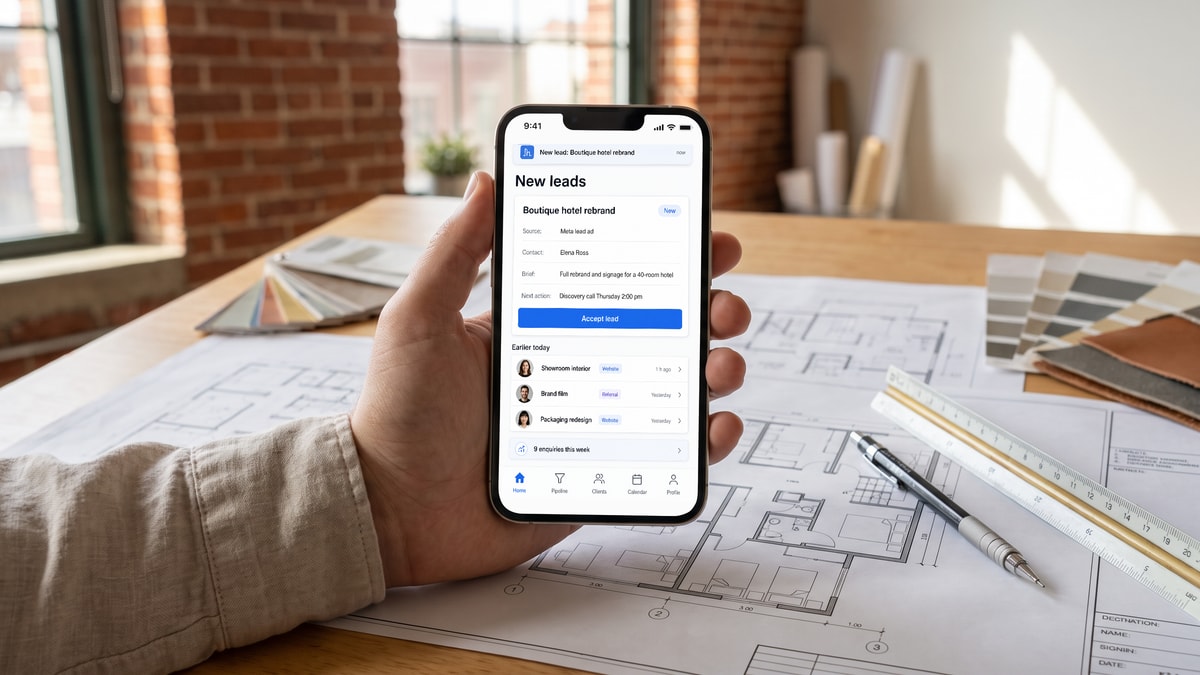
- Alerts where staff already are. Studio people are on site, at a shoot or in a client meeting. A lead that only appears on a desktop dashboard is a lead that waits, so notifications (WhatsApp, for example) matter.
For the full service description, including how we scope and phase a bespoke build, see our custom CRM development service page. This article is about how that work applies to studios specifically.
What a CRM for design and architecture studios needs to do
It needs to capture every enquiry automatically, show where each opportunity stands, and keep the project context a client conversation depends on. Everything else is optional.
In practice that means a capture layer connected to your ad accounts and website, a pipeline that matches how you really sell (enquiry, discovery call, proposal, negotiation, kick-off) and a client record that carries notes, files and history. Add notifications so staff hear about a lead the moment it lands, and a way to mark a lead as won, lost or parked with a reason, so your marketing can be judged on pipeline instead of clicks.
Where WhatsApp or SMS is part of how your clients talk to you, the same record should log those conversations. We have implemented WhatsApp API automation for clients, including the two projects below.
The studios we build for
Many studios in the United States are small and senior-led: a Brooklyn loft, a Main Street architecture practice, a production company in a suburban office park. Referrals tend to matter most, paid campaigns are often part of the mix, and the principal is frequently the sales team.
That shapes the build. Systems have to be simple enough for people whose day job is not software. Our packages give you a starting price, and we fix the final quote after discovery, because a studio with one ad channel and one pipeline is a very different job from a multi-office practice with consultants and subcontractors on the record.
In-house CRM development or a specialist team
In-house CRM development works when you already employ engineers who will own the system for years. Most studios do not, and a specialist team is the faster and safer route. The people who know your craft are not the people who should be debugging a lead webhook at 9pm.
- An in-house build puts the system in the hands of someone who knows your business, but it ties up scarce engineering time and the knowledge walks out when that person does.
- A freelance build is quick to start, but continuity is a risk when the CRM changes an API or an ad platform alters its lead form.
- A specialist team brings the integrations, the data model and the support under one contact, with a process map up front and a hand-off at the end, and you own the codebase and the data.
If you want to compare, send us what you have and we will tell you plainly which route we would take in your position, including when that is not us.
Custom build or HubSpot and Zoho: choosing honestly
If your process fits inside a platform, use the platform. HubSpot suits marketing-led studios that want forms, email and reporting in one place. Zoho suits cost-conscious teams that want flexibility and WhatsApp-friendly automation. A custom build earns its place when you keep fighting the tool: role rules it cannot express, project data it cannot hold, or an internal system it cannot connect to.
We implement both platforms and build custom, so we have no stake in pushing you towards either. A studio that starts on a platform and outgrows it can also move later, ideally with the data cleaned first.
Work we have shipped
Two live projects where we worked on WhatsApp lead capture and follow-up.
- Easy Wedding (easywedding.me) is the flagship site of a multi-country wedding-planning network. We delivered Zoho CRM implementation, SEO, web development, campaign management and a WhatsApp API chatbot. It is a service business that sells on enquiry.
- T72 (t72.ae) is a UAE events management company. We implemented WhatsApp API automation and a chatbot, and built the JINo Debut launch microsite with a countdown timer, using WhatsApp as the main lead-capture and enquiry channel for the event.
From scattered contacts to one pipeline
The usual starting point is messy, and that is fine. Contacts are spread across Facebook, Instagram, email, text and calls, and sometimes the only record is a person's head or a page of notes. We begin by mapping how work moves, then build in phases so you see a working pipeline early. Existing contacts are mapped and cleaned before anything goes live.
If paid leads are a big part of your pipeline, the capture layer matters as much as the CRM. Our lead generation work covers the capture and routing around it, and our WhatsApp automation pages cover messaging when your clients prefer it.
Common questions
It is building a CRM around how your studio sells and delivers: leads from ads, the website and inbox in one queue, a pipeline that matches your stages, project context on the client record, and role-based access for principals, managers and staff. It differs from configuring a template by modelling your process first.
Yes. We connect Meta and Google lead forms into one pipeline, log each lead with its source and route it to an owner, with WhatsApp notifications where that suits your team. The aim is a fast first reply instead of whenever someone next checks the ad account.
In-house makes sense if you already employ engineers who will own the system long term. Most studios are better served by a specialist team that handles the integrations and support, with a hand-off so you are not dependent on a single person.
If your process fits inside a platform, use one. We implement both HubSpot and Zoho. A custom build is worth considering when role rules, project data or an internal system keep forcing workarounds. We will tell you which fits before any build starts.
On Zoho or HubSpot, from USD 790 (AED 2,900) for one pipeline and up to 5 users, or USD 1,225 (AED 4,500) with migration, scoring and WhatsApp sync. Custom CRM builds start from USD 3,000 (AED 11,000), with a custom quote for larger implementations. Platform licences are separate.