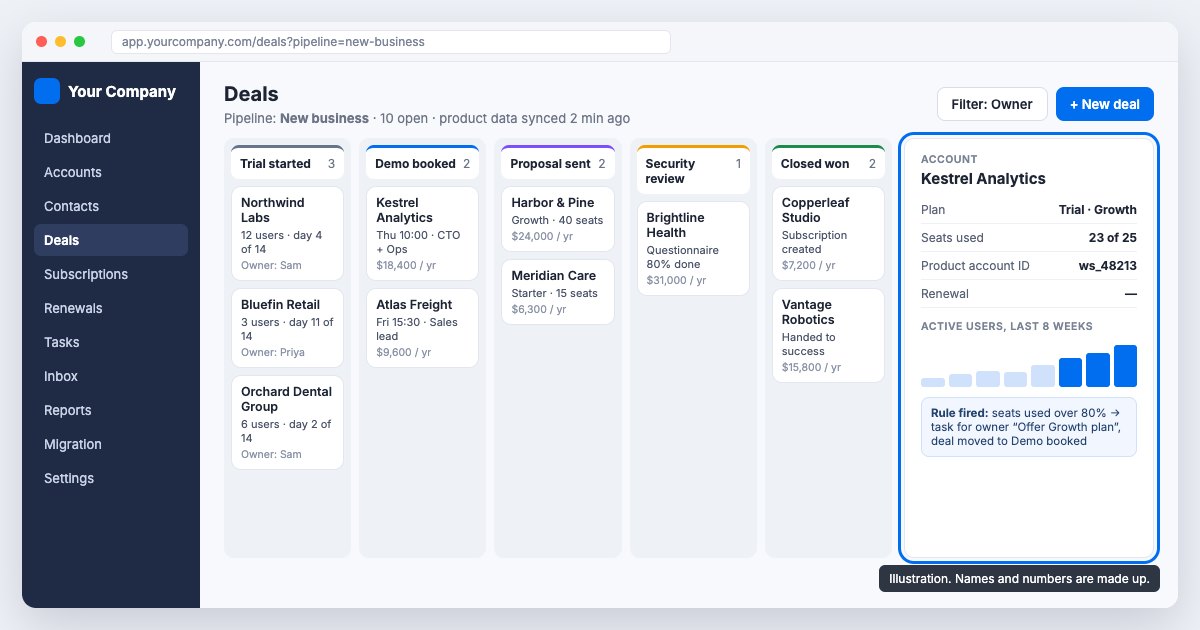
Software and IT companies are an awkward fit for most off-the-shelf CRMs. You sell to businesses over weeks or months. The best signal about a deal sits in your own product: who signed up for the trial, how many seats they added, which feature they used on day three. And most of the revenue arrives later, as renewals and upgrades, not as the first closed deal.
We are GoDesign, a web, CRM and AI automation team with offices in Dubai and Islamabad, working with clients in the United States, Europe and the Gulf since 2018. This guide is for founders, sales leaders and operations heads at SaaS, software and IT services companies. It covers when custom CRM development is worth it, what we build, and how a project runs from first call to handover.
What is custom CRM development for a software company?
CRM development means designing and building a CRM around how you actually sell and keep customers, rather than bending your process to fit a template. For a software company it is usually one of two quite different projects.
| A CRM for your own team | A CRM you sell as a product | |
|---|---|---|
| Who uses it | Your sales reps, customer success, finance and leadership | Your customers' teams, each in their own account |
| What it holds | Leads, deals, accounts, subscriptions, renewals and product usage | Whatever your customers sell, inside tenant-isolated accounts |
| Hardest part | Joining product data, billing and the pipeline | Multi-tenancy, billing per tenant and white-label branding |
| First release | One pipeline and the integrations it depends on | One workflow done well for one type of customer |
Most enquiries we receive are the first kind. A growing number are the second: founders who want to license a CRM to an industry they know, often white-labelled for resellers. We build both, and the rest of this guide covers each.
When does custom CRM development beat HubSpot, Zoho or Salesforce?
Custom development wins when the platform keeps forcing workarounds you pay for every week. If your process fits inside HubSpot or Zoho, use it: it is cheaper to set up, cheaper to run and easier for a new hire to learn, and we will tell you that on the first call. Software companies tend to outgrow a platform in a few specific ways.
- Product data has to drive the pipeline. Trial sign-ups, activation events, seat counts and usage limits should create deals, move stages and alert the right rep. Pushing all of that into a platform's custom properties gets fragile fast.
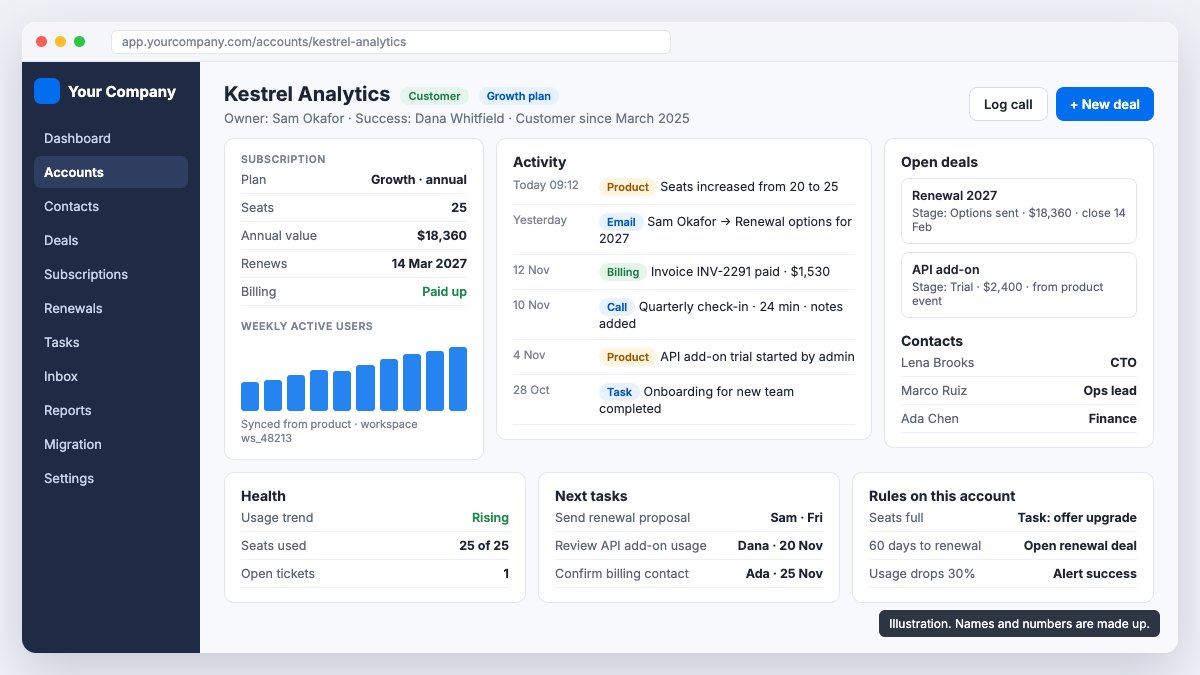
- Your revenue is subscriptions, not one-off deals. Renewals, upgrades, downgrades and churn risk need their own records and their own pipeline, tied to billing, not deal names with "renewal" typed into them.
- Permissions a platform cannot express. Resellers who must see only their own accounts, regional managers, an executive view, a partner portal.
- Per-seat licences are stacking up. A large sales and support team on a premium tier can pay more each year in licences than a build costs once.
- The CRM is the product. If you plan to sell it, you need to own it.
What features should a custom CRM have?
We build the records and rules your team needs every day, and nothing that will sit unused. For a software or IT services company that usually means these modules, scoped to what you need in the first release.
- Accounts and contacts with company hierarchy, so a parent company, its subsidiaries and every buyer and user sit in one place.
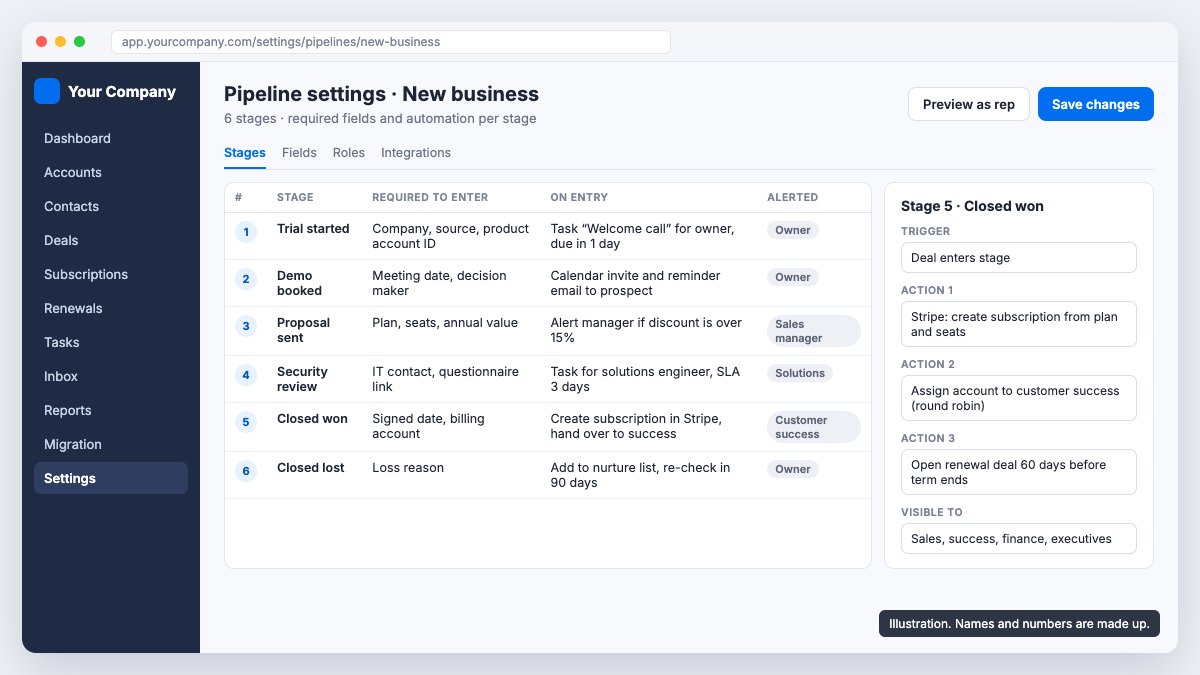
- A pipeline engine with your stages, the fields each stage requires, and automation on every stage change: tasks for the owner, follow-up emails, alerts to a manager.
- Product data sync over webhooks or your API: sign-ups, trial activity, plan, seats and usage on the account record, with rules that create or move deals.
- Subscriptions and renewals synced with Stripe or your billing system, and a renewal pipeline that opens weeks before the date, not on it.
- Roles and permissions for reps, managers, finance, executives and, where needed, partners or resellers.
- Communication on the record: email and calendar sync with Google Workspace or Microsoft 365, call logging, and WhatsApp where your customers use it.
- Reporting on pipeline value, conversion by stage, rep activity, renewals due and forecast, from the same data your reps work in.
Predictive features, such as conversion probability or a sales forecast, come up in many briefs. They are only as good as the history behind them, so we build them once there is clean data to work from, starting with a lead score your team can read and question. Where AI is part of the build, we connect to an existing AI service and work from your own data. We do not train our own models.
How is a white-label or multi-tenant CRM different to build?
When you plan to sell the CRM, the hard work moves from features to the layer underneath them. Contacts, deals and tasks follow well-known patterns. What decides whether the product survives its first hundred customers is the following.
- Tenant isolation. Every customer's data kept apart, whether in a database per tenant or a shared database with strict tenant scoping. We choose with you, based on how many tenants you expect, your compliance needs and hosting cost, and write down why.
- Tenant administration. Creating, suspending and closing customer accounts from an admin screen, not from the command line.
- Billing per tenant. Plans, trials, upgrades and failed payments handled through Stripe or a comparable gateway.
- White-label options. A reseller's logo, colours, domain and email sender, where your model needs them.
- Onboarding and import. A new customer should be able to bring their contacts in on day one without asking you.
- Audit logs and access control that a buyer's IT team will ask about before they sign.
The briefs we see for CRM products often list fifteen or twenty features. Our advice is to launch with one workflow done properly for one type of customer, such as engagement segmentation for retailers or a sales pipeline for a single trade, and earn the right to build the rest. A narrow first version gets paying customers sooner and tells you what to build next.
What is the custom CRM development process?
A project runs in phases, each with a sign-off, and you see a working pipeline early instead of a big reveal at the end. This is the sequence we follow.
- 1Discovery and process map. We sit with the people who will use the system (sales, success, finance) and write down the real steps, decisions and exceptions, including the ones nobody mentions in the brief.
- 2Data model and prototype. What an account, a deal and a subscription mean in your business, how they relate, and a clickable prototype of the main screens.
- 3Core build. Accounts, contacts, the pipeline and roles first, so your team can try it with real records in the first few weeks.
- 4Integrations. Product events, billing, email and calendar, forms, WhatsApp, accounting, added one at a time and tested against live data.
- 5Data migration. Records from your current CRM or spreadsheets mapped to the new model, de-duplicated and checked before go-live.
- 6User testing and launch. Your reps work real deals in it before the switch, then the old system becomes read-only.
- 7Handover and support. Documentation, the repository, the database and the hosting account in your name, with support for changes after launch.
Most custom CRMs go live in 8 to 12 weeks, depending on workflows and integrations. A multi-tenant CRM product with billing and white-label options is a larger build, and we quote it after discovery.
Which stack, and who owns the code?
We pick the stack for your team and scale, not from a template: typically a modern web application with a Postgres database, role-based authentication and a clean API, plus a mobile app where reps work away from a desk. If your own engineers will maintain the CRM later, we build in the languages they already use, so the handover is real.
You own the codebase and the data outright. The repository, the database and the hosting account are in your name, hosted in the region you choose. There is no per-seat licence and no vendor changing its pricing under you. The trade-off is that maintenance becomes yours, either through a support arrangement with us or with your own developers.
In-house CRM development or an agency: which is better?
In-house CRM development makes sense when you have engineers to spare who will own the system for years. In most software companies that is not true. Engineers belong on the product, so the internal CRM slides down the backlog, half-finished, and sales goes back to spreadsheets.
A specialist team brings the data model, the integrations and the support under one contact, works to a fixed scope, and hands over cleanly. A common route is that we build and launch the first version, and your own team takes over once they know the codebase. We are a 16-person team that has delivered over 900 projects, so a CRM build is regular work for us rather than a side project.
Why do custom CRM projects fail?
Most custom CRM projects that fail do so for the same few reasons, and none of them is the code. These are the ones we plan around from the first call.
- A first release that tries to do everything. Briefs with fifteen or twenty features take months before anyone uses them. We launch one pipeline done properly and add the rest once the team is working in it.
- Built without the people who will use it. Discovery sits with sales, success and finance, and reps work real deals in the CRM before the switch.
- Dirty data moved across. Duplicates and free-text stages carried into a new system make it untrustworthy on day one, so cleaning and mapping come before go-live.
- Nobody owns it after launch. An internal CRM with no owner slides down the backlog. You get the code, the documentation and a support option, so changes keep happening.
How much does custom CRM development cost?
Custom CRM builds start from USD 3,000 (AED 11,000) for a focused scope, with a custom quote for larger work such as a multi-tenant product, ERP sync or native mobile apps. If a platform fits better, HubSpot or Zoho setups start from USD 790 (AED 2,900), and platform licences are paid to the vendor.
Budget for three lines: the build, hosting and support for changes. What moves the build cost most is the number of roles, the number of systems the CRM must talk to, whether product data syncs in real time, mobile apps and how messy the data you are migrating is. We quote a fixed scope after discovery, not an hourly estimate that grows.
Work we have done
Three live projects where we built systems that replaced scattered tools or put enquiries into one place:
- Claim Cash Now is a pre-settlement funding company. We designed and built a multi-portal web application with separate admin and client portals, application tracking, lien management, automated document generation and reporting, replacing a process that had run on spreadsheets and email.
- Easy Wedding (easywedding.me) is the flagship site in a multi-country wedding-planning network. We delivered Zoho CRM implementation, SEO, web development, campaign management and a WhatsApp API chatbot.
- T72 (t72.ae) is a UAE events management company. We implemented WhatsApp API automation and a chatbot, with WhatsApp as the main lead-capture and enquiry channel for a launch microsite.
Across our work we hold a 4.9 rating from more than 900 reviews. If you run a design, architecture or media studio rather than a software company, our studio guide covers that version of the problem.
Common questions
It is building a CRM around your own sales and account process instead of configuring a template: your stages, your records (such as subscriptions and renewals), your permissions and the integrations your team depends on. You own the code and the data.
Most custom CRMs go live in 8 to 12 weeks, depending on workflows and integrations. You see a working pipeline in the first few weeks. A multi-tenant CRM product with billing and white-label options takes longer and is quoted after discovery.
Yes. We build tenant isolation, an admin area to create and suspend customer accounts, billing per tenant through Stripe or a comparable gateway, and white-label branding where your model needs it. We recommend launching with one workflow for one type of customer first.
Yes. We sync product events over webhooks or your API, subscriptions from Stripe or your billing system, email and calendar from Google Workspace or Microsoft 365, and WhatsApp where customers use it. Unusual systems are scoped during discovery so they are in the quote from day one.
Only if you have engineers who can own it for years without slowing the product. Most software companies get further with a specialist team that builds and launches the first version, then hands over the code and documentation so their own developers can take it on.
Custom CRM builds start from USD 3,000 (AED 11,000) for a focused scope, with a custom quote for larger builds such as a multi-tenant product or ERP sync. HubSpot or Zoho setups start from USD 790 (AED 2,900), with licences paid to the vendor.